


Hong Kong Immigration Is Changing. So Are We.
Posted in Feature Article, Musing, The Hong Kong Visa Geeza /
Hong Kong Immigration Is Changing. So Are We.
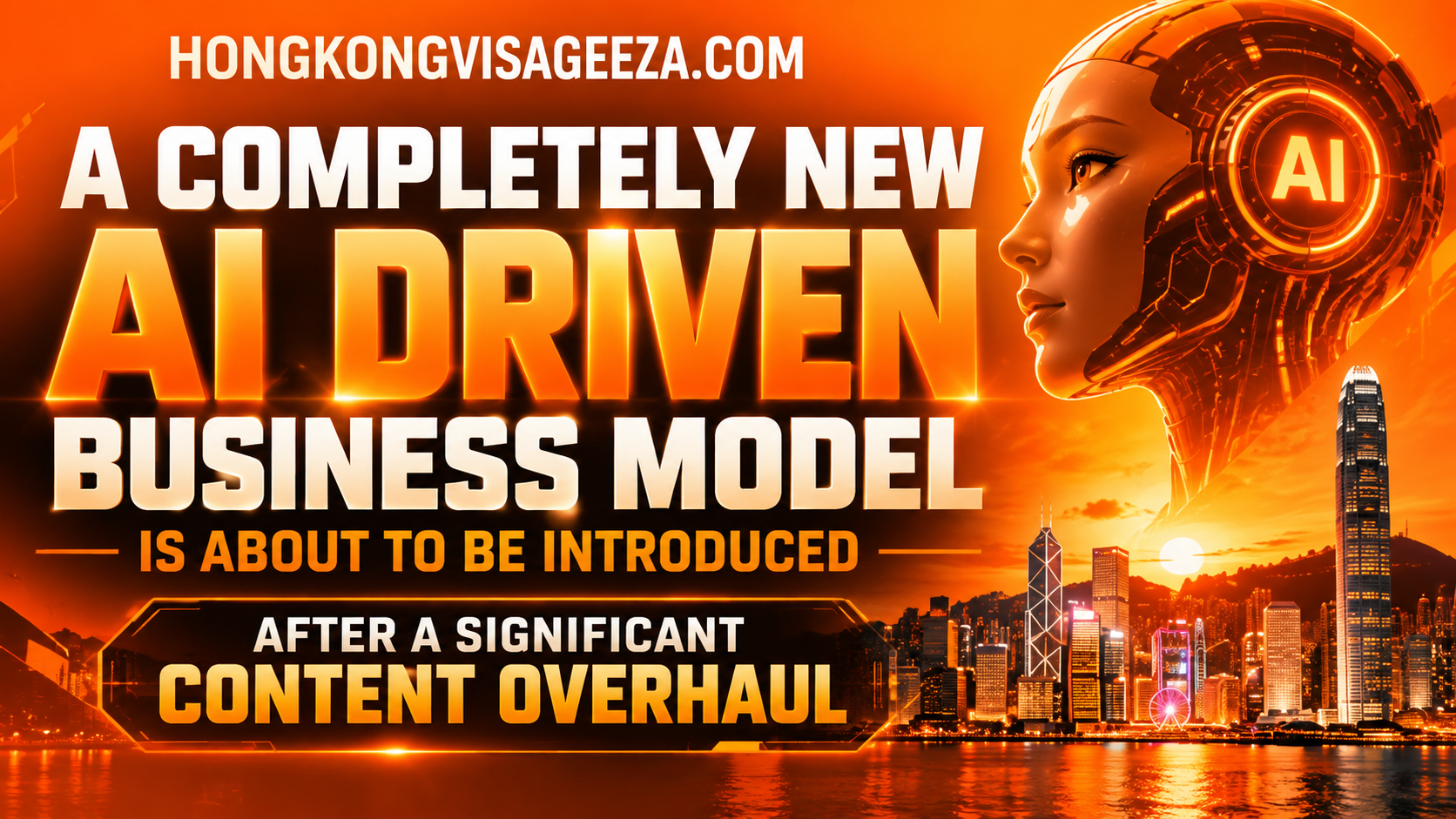
Regular visitors to the Hong Kong Visa Geeza website may have noticed that parts of our extensive immigration knowledge library have not been updated as frequently as they once were.
There is a reason for that.
Behind the scenes, we have been undertaking what is probably the most significant reworking of our immigration knowledge and know-how since the Hong Kong Visa Centre was established.
For more than 30 years, our work has been built upon practical experience of Hong Kong immigration: understanding not simply what the rules say, but how immigration policy develops, how applications are considered in practice, and how changes in Hong Kong’s economy eventually find their way into immigration policy and decision-making.
We are now combining that accumulated knowledge with a new generation of artificial intelligence.
From Visa Geeza AI to a new immigration knowledge platform
We previously introduced the idea behind Visa Geeza AI and our first experiments in bringing artificial intelligence into the Hong Kong immigration information environment.
AI has developed extraordinarily quickly since then.
So have we.
Rather than simply attaching an AI interface to an existing collection of articles, our objective has become considerably more ambitious: to organise decades of Hong Kong immigration knowledge and practical experience into a body of information that can increasingly be interrogated using artificial intelligence while remaining grounded in authoritative immigration rules, current policy, and real-world practice.
That work has required us to look again at the entire platform.
It has also coincided with one of the more consequential periods of change in Hong Kong’s immigration and talent policies.
Hong Kong itself is changing
Hong Kong’s economic development is becoming more deliberately connected with the development of Mainland China and, particularly, the Guangdong-Hong Kong-Macao Greater Bay Area.
That direction has now become considerably clearer with Hong Kong’s first Five-Year Plan for Economic and Social Development for 2026–2030.
The Plan places innovation and technology at the centre of Hong Kong’s next phase of development. Artificial intelligence and robotics, life and health technology, microelectronics, advanced manufacturing, new energy, and new materials all feature prominently.
Hong Kong is simultaneously developing its role within the Greater Bay Area, including deeper innovation and technology collaboration with Shenzhen, while continuing to develop its particular strengths in finance, professional services, research, international connectivity, and the commercialisation of technology.
AI, fintech, tokenisation, and digital assets are consequently no longer peripheral subjects. They form part of the emerging economic environment in which Hong Kong intends to compete.
And people are fundamental to making that strategy work.
Immigration policy is part of the picture
Hong Kong’s talent admission policies have already changed substantially.
The Top Talent Pass Scheme is perhaps the clearest example. Introduced as Hong Kong intensified its efforts to compete internationally for talent, the scheme created a route through which qualifying high-income individuals and graduates of eligible universities could enter Hong Kong without first securing a Hong Kong job offer. The policy has continued to evolve since its introduction.
At the same time, traditional routes have also shifted. In particular, the assessment criteria for the Investment as Entrepreneurs (Entrepreneur Visa) scheme have significantly tightened and evolved. The Immigration Department no longer evaluates business investment merely on baseline commercial viability or modest capital injection. Today, applicants face substantially heightened scrutiny regarding their ability to make a substantial contribution to Hong Kong’s economy—with decisive weight placed on genuine local job creation, substantial capital commitment, verifiable commercial ties to emerging priority industries, and alignment with the broader strategic focus on technology, innovation, and high-value professional sectors.
More broadly, Hong Kong continues to face structural manpower constraints. Government projections previously indicated a potential manpower shortage of approximately 180,000 by 2028. The Government’s September 2026 mid-term update now projects that gap at approximately 130,000, in part reflecting the impact of talent admission and labour-importation measures already introduced.
Significant shortages nevertheless remain in important areas of the economy, including innovation and technology.
That matters for immigration practitioners.
Immigration rules cannot sensibly be understood in isolation from the economic and manpower policies they are intended to support.
Why we haven’t simply been rewriting old articles
That brings us back to this website.
Our library contains many years of Hong Kong immigration information, analysis, and practical know-how.
Some of it remains entirely relevant.
Some of it needs additional context.
Some has been overtaken by subsequent policy developments.
And some will need to be replaced.
Instead of pretending otherwise—or quietly changing hundreds of pages without explaining what has happened—we are going to make the process visible.
We are introducing a new series of Hong Kong Visa Centre Practice Directions.
Each Practice Direction will address a particular immigration category or area of practice and set out our current understanding of the relevant rules, policy, and practical considerations.
Where older articles in our library remain useful, we will link to them and explain how they should now be read in light of the latest Practice Direction.
Over time, these Practice Directions will form a new current-information layer across the Hong Kong Visa Centre platform.
Thirty years of experience. A new generation of technology.
Artificial intelligence gives us tools that simply did not exist when the Hong Kong Visa Centre began.
What AI does not possess by itself is three decades of accumulated practical experience.
Our objective is to bring those two things together.
The result will not appear overnight. Our library is extensive, immigration policy continues to evolve, and accuracy matters more to us than the appearance of having updated everything at once.
So we are going to do this progressively, transparently, and carefully.
You will begin seeing new Practice Directions appearing across the platform, together with a new visual identity identifying material that has passed through this latest review process.
Consider this our flag in the ground.
The Hong Kong Visa Centre is changing because Hong Kong immigration is changing—and because the technology available to organise, interrogate, and deliver three decades of immigration knowledge has changed as well.
We look forward to showing you what comes next.
VisaGeeza.Ai – Making Hong Kong Immigration A Lot Easier

VisaGeeza.Ai – 13 Years In The Making
Check Out VisaGeeza.Ai
All Our Know-How : All Our Experience : Fully Interactive
100% FREE!
Please select the social network you want to share this page with:

The Hong Kong Visa Geeza (a.k.a Stephen Barnes) is a co-founder of the Hong Kong Visa Centre and author of the Hong Kong Visa Handbook. A law graduate of the London School of Economics, Stephen has been practicing Hong Kong immigration since 1993 and is widely acknowledged as the leading authority on business immigration matters here for the last 24 years.

