


PRACTICE UPDATE: The GEP Work Visa Policy | A New Era of Skills-Based Immigration
Posted in Employment Visas, Feature Article, Musing, The Hong Kong Visa Geeza /
GEP Work Visa | The General Employment Policy Enters a New Era of Skills-Based Immigration

The Evolving GEP Work Visa Assessment Regime, Technical Professionals Stream and Employer Sponsorship Requirements
GEP Work Visa: For more than three decades, the General Employment Policy (GEP work visa) has been one of the principal mechanisms through which Hong Kong has attracted overseas professionals to participate in its economy.
Traditionally, the scheme has been built around a relatively straightforward proposition: an overseas applicant possessing special skills, knowledge or experience of value to Hong Kong may be permitted to take up employment where the proposed position cannot readily be filled by the local workforce. That principle remains fundamental to the GEP. However, the economic and policy environment in which the scheme operates has changed considerably. Hong Kong is now pursuing a more deliberately structured approach to manpower development, technological innovation and international talent attraction.
Stephen Barnes – Hong Kong Visa Geeza
The expansion of the Hong Kong Talent List, the introduction of a new Technical Professionals Stream in June 2025 and the Government’s wider economic planning priorities all point towards an increasingly differentiated employment immigration framework.
For employers and prospective applicants, these developments require a fresh understanding of how the Hong Kong Immigration Department assesses overseas recruitment. The significant development is not that Hong Kong has abandoned its traditional professional employment requirements. It is that the Government has introduced more targeted admission arrangements alongside them, reflecting a growing recognition that Hong Kong needs different categories of overseas skills to support its economic development.
This Practice Direction examines the current GEP framework, the changes affecting employers and applicants, and the practical implications for Hong Kong employment visa applications.
From a Traditional Professional Immigration System to a More Targeted Skills Strategy
Historically, the GEP Work Visa has focused primarily on individuals possessing recognised academic qualifications, specialist professional experience or other credentials demonstrating that their skills are not readily available locally. The scheme is quota-free and non-sector-specific. Applicants are generally expected to demonstrate that they possess qualifications or experience appropriate to the position, that there is a genuine employment vacancy and that the proposed remuneration is consistent with prevailing market levels. The employing company must also establish that the proposed employment is genuine and commercially credible.
These requirements have long provided the foundation of the GEP Work Visa, as explored across the Hong Kong Visa Geeza Guide to the Employment Visa and the corporate framework on Hong Kong Visa Sherpa.
However, Hong Kong’s manpower requirements are becoming more complex. The economy increasingly requires not only university-educated professionals but also experienced technical personnel possessing specialised vocational and industrial skills. This is particularly relevant to sectors connected with advanced manufacturing, aviation, transport, infrastructure and technology.
Stephen Barnes – Hong Kong Visa Geeza
The Government has consequently introduced targeted measures designed to facilitate the admission of workers whose capabilities may be economically important even where they do not possess traditional university qualifications.
The June 2025 Technical Professionals Stream: A Significant Development for The GEP Work Visa
One of the most consequential recent changes was the introduction of the Technical Professionals Stream under GEP and ASMTP. Introduced in June 2025, the new arrangement provides a route for qualifying non-degree professionals with relevant technical expertise.
This is a meaningful departure from the conventional emphasis on degree-level professional qualifications. Under the pilot arrangements:
- Applicants must generally be between 18 and 40 years of age.
- They must possess the qualifications, technical capabilities and experience specified for an eligible skilled trade.
- The scheme covers eight designated skilled trades.
- The pilot operates for three years.
- An overall application quota of 10,000 applies across the GEP and ASMTP technical streams.
- Individual skilled trades are subject to a maximum application quota of 3,000.
Depending upon the occupation and applicable requirements, successful applicants may receive an initial visa valid for 24 or 36 months.
This new route should not be confused with the conventional GEP work visa route. The ordinary professional stream remains quota-free and non-sector-specific, while the Technical Professionals Stream is restricted to designated occupations and subject to its own eligibility requirements and quota. Nevertheless, the introduction of the stream demonstrates an important change in Hong Kong’s approach to overseas skills. Professional value is no longer being considered exclusively through the traditional lens of university education and white-collar professional employment. The Government is also identifying particular technical capabilities that are important to the territory’s economic development.
The Talent List and the Changing Meaning of Skills Shortages
The expansion of Hong Kong’s Talent List provides further evidence of the Government’s more targeted approach. An updated Talent List took effect in March 2025, bringing the number of specified professions to 60. The list identifies occupations in which Hong Kong considers there to be particular shortages of relevant talent.
Its importance is not simply descriptive. Under applicable facilitation arrangements, employers recruiting individuals for qualifying Talent List positions may benefit from simplified evidential requirements concerning local recruitment difficulties, an exemption similarly reflected in the Visa Geeza Employment Visa Guidelines. A separate facilitation measure may also apply where the annual remuneration package for a proposed position reaches HK$2 million.
However, these measures must be understood correctly. In particular, an exemption from demonstrating local recruitment difficulties does not eliminate the need to establish the genuineness of the vacancy, the applicant’s suitability, the appropriateness of remuneration or compliance with the other applicable immigration requirements. Nor does inclusion of a profession on the Talent List guarantee approval. The Department retains discretion to assess applications on their individual merits.
Stephen Barnes – Hong Kong Visa Geeza
The Employer’s Role: Genuine Vacancy, Credible Business and Appropriate Remuneration
For conventional GEP work visa applications, the employing company remains central to the assessment. A successful application is not simply a question of whether the applicant possesses a degree or has accumulated sufficient professional experience. The Department must also be satisfied that the proposed employment arrangement is genuine.
Relevant considerations include the nature of the employer’s business, the proposed role, the applicant’s qualifications, the remuneration package and the reasons why the position is appropriate for the particular individual.
Employers preparing documentation can refer to corporate filing frameworks such as Hong Kong Visa Sherpa’s Application Guides and may be required to provide:
- A signed employment contract or formal appointment letter.
- A valid Business Registration Certificate.
- Evidence of financial standing.
- Information concerning the company’s activities and commercial operations.
- Details of the applicant’s proposed duties and responsibilities.
- Supporting information explaining the commercial need for the position (including declarations of local recruitment efforts).
For newly established businesses, a detailed business plan may also be required. Importantly, some documentary requirements may be waived under applicable facilitation measures.
The central question remains whether the proposed employment is credible and consistent with the requirements of the GEP work visa. A large multinational employer may be able to demonstrate these matters through an established operational history. A smaller or newly established company may need to provide more detailed evidence of its commercial activities, financial resources and reasons for employing the applicant. Neither size nor age of the business should be treated as an automatic determinant of eligibility.
Salary Assessment: There Is No Universal Minimum GEP Work Visa Salary
One of the more persistent misunderstandings surrounding Hong Kong employment visas concerns salary. As discussed in practical analyses like Hong Kong Visa Geeza: What’s the Minimum Salary?, the GEP does not impose a single statutory minimum monthly salary applicable to every professional occupation.
Instead, the Immigration Department ordinarily requires the proposed remuneration package to be broadly commensurate with prevailing market levels for comparable professionals in Hong Kong.
This means that remuneration must be assessed in context. The appropriate package for an experienced technology executive may be very different from that for a junior professional or specialist employee. The Department may consider basic salary, accommodation benefits, medical benefits and other contractual remuneration.
Employers should therefore avoid assuming that offering a particular fixed salary automatically guarantees that the remuneration requirement has been satisfied. Equally, a relatively modest salary does not necessarily establish that an application must fail. The assessment depends upon the role, the applicant’s credentials, prevailing market conditions and the wider circumstances.
This is particularly important for start-ups offering combinations of cash remuneration, equity incentives and other benefits; an equity-based arrangement should not automatically be treated as equivalent to a reliable market-level salary.
Graduate Recruitment: A More Nuanced Assessment
Another area requiring careful consideration concerns newly qualified graduates. Historically, the GEP has generally been associated with professionals possessing skills or experience that are not readily available in Hong Kong. This can create difficulties for applicants seeking entry-level positions.
However, as highlighted in Visa Geeza’s Post-Graduation Experience Analysis, it would be incorrect to suggest that every recent graduate is automatically excluded from the scheme.
The Immigration Department’s published eligibility criteria do not impose an absolute universal minimum number of years of post-graduation experience. Instead, the assessment considers the applicant’s qualifications, the nature of the position, the employer’s requirements and whether the employment can readily be undertaken by the local workforce.
A recent graduate recruited into a highly specialised role or a structured international management programme may present different considerations from an applicant seeking an ordinary entry-level position. The identity and credibility of the employer, the substance of the proposed training or employment and the applicant’s particular attributes may all become relevant.
The appropriate approach is therefore to assess the complete employment proposition rather than rely upon a simplistic assumption that new graduates are either always eligible or always ineligible.
Intercompany Transfers: International Mobility Remains Important
The GEP work visa also continues to facilitate the transfer of professionals between international group companies, a category detailed under Hong Kong Visa Geeza’s Intercompany Transferee Insights.
Such applications may arise where an overseas business wishes to transfer an executive, manager or specialist employee into its Hong Kong operations. The existence of an established employment relationship within an international group can provide important evidence of the applicant’s professional background and the commercial rationale for the transfer.
However, the application must still satisfy the relevant immigration requirements. The Department may examine the relationship between the overseas and Hong Kong entities, the applicant’s actual duties, the employment arrangements and the economic purpose of the transfer.
Particular care is required where the individual is an independent contractor rather than a formal employee of the overseas group. In those circumstances, the documentation must accurately explain the proposed Hong Kong employment relationship.
An intercompany transfer is not an automatic exemption from the GEP’s substantive eligibility criteria.
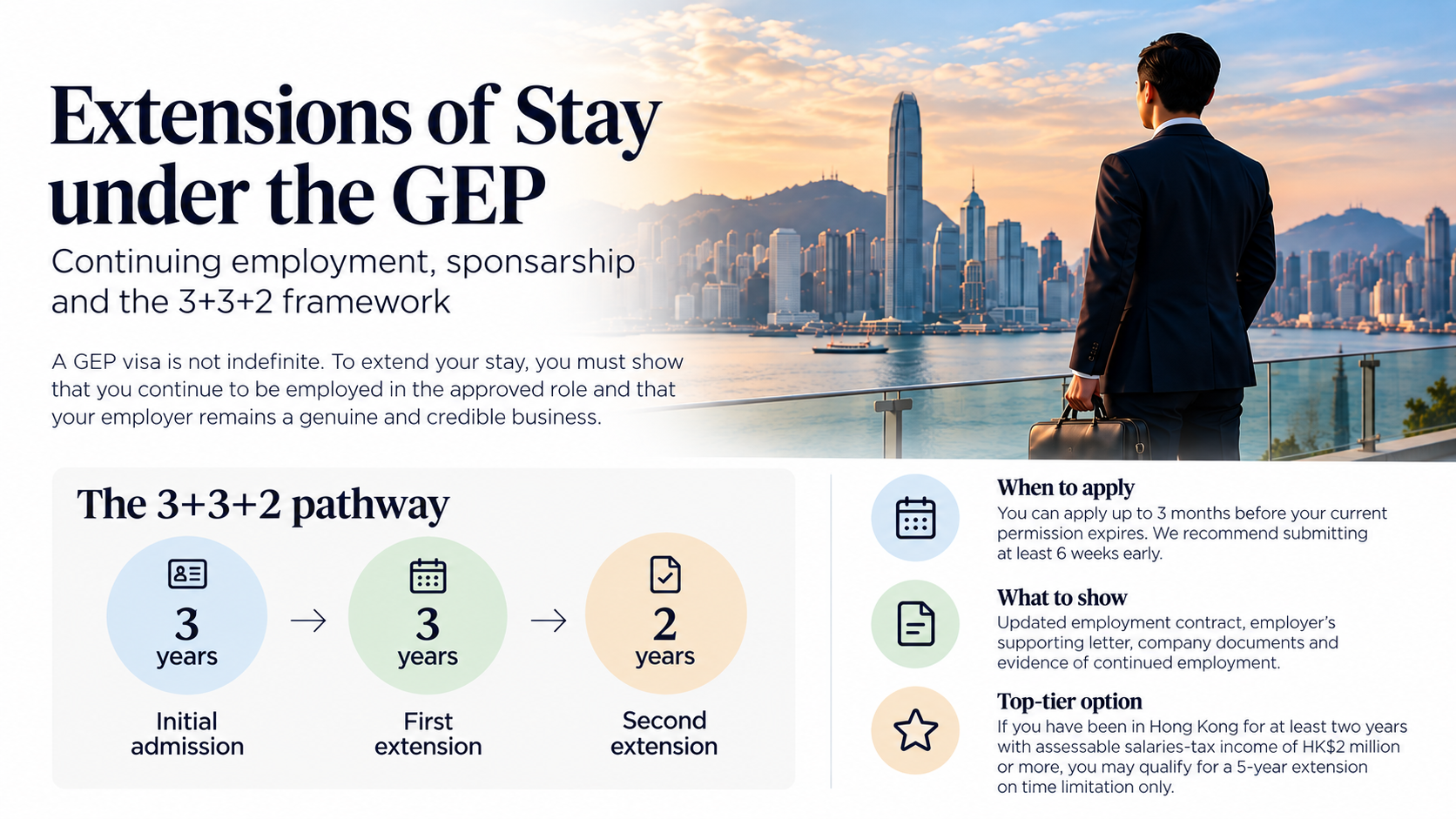
GEP Work Visa Extensions of Stay: Continuing Employment, Sponsorship and the 3+3+2 Framework
GEP Work Visa Extensions, Changes of Employment, and Path to PR
A General Employment Policy (GEP) visa does not confer an unconditional right to remain in Hong Kong indefinitely. Because ordinary GEP permission is tethered to a specific approved employer, the Hong Kong Immigration Department (ImmD) treats extensions not as rubber-stamp renewals, but as continuous verifications that qualifying employment remains genuine. As detailed across the Hong Kong Visa Geeza Guide to Employment Visas and the procedural guidance on Hong Kong Visa Sherpa, maintaining compliance across all facets of sponsorship is essential.
Permitted Pattern of Stay (3+3+2)
Conventional GEP entrants are granted permission to stay under a 3+3+2 year model:
| Standard Permitted Stay | |
| Initial Admission | Up to 36 months |
| First Extension | Up to 36 months |
| Second Extension | Up to 24 months |
All grants remain capped by the actual duration of the underlying employment contract. If a contract runs for only one year, the extension will match that term rather than the default multi-year maximum.
The Extension Window & Timelines
- Filing Window: Applications can be submitted up to 3 months prior to the current limit of stay. ImmD recommends submitting as early as possible within this window and at least 6 weeks before expiry. Eligible individuals can submit via the GovHK Online Application for Extension of Stay portal.
- Routine Processing: Approximately 2 to 3 weeks once all required documents and application fees are received.
- Status Maintenance: Submitting an extension does not create a bridging visa or automatically preserve status. If a visa expires while an application is pending, the holder falls out of lawful status and must depart Hong Kong unless exceptional discretionary permission is granted.
Documentation Requirements (Continuing Employment)
When remaining with the same sponsor, applicants must prepare their submissions in accordance with ImmD Form ID 91 guidelines and Hong Kong Visa Sherpa Extension Preparation Guides:
- Valid travel document and current e-Visa.
- Hong Kong Identity Card (HKIC).
- Formal employer letter confirming the applicant’s existing title, confirmed ongoing employment period, and complete monthly remuneration breakdown.
- Proof of salaries tax assessment or recent pay slips (if requested).
Changes of Employment (GEP Work Visa Change of Sponsorship)
Unlike open visas (such as the Top Talent Pass Scheme (TTPS) or IANG), ordinary GEP visas are strictly tied to a single employing entity:
Prior Approval Required: A visa holder cannot start work for a new employer upon signing an offer; prior approval from ImmD is mandatory. Practical steps for handling transitions and ending dates are covered in Visa Geeza’s Guide to Changing Employment Visa Sponsorship and the Last Day of Work / “Bye-Bye Letter” Protocols.
Substantive Review: ImmD re-evaluates the application as a new sponsorship—assessing business credibility, job suitability, local recruitment attempts (unless exempt under the Talent List or HK$2M salary tier), and remuneration parity.
Top-Tier Employment Stream: 5-Year Extension
Experienced and highly remunerated professionals can bypass the standard renewal cycle and employer-specific restrictions under the GEP Top-Tier Employment Stream:
Eligibility Criteria:
Admitted to work under the GEP for at least 2 continuous years.
Assessable income for salaries tax of not less than HK$2 million in the previous year of tax assessment, verified via an Inland Revenue Department (IRD) notice of assessment.
Key Benefits:
Grants a 5-year extension.
Issued on time limitation only, removing standard sponsorship restrictions. Holders can switch employers freely and only need to notify ImmD of changes via online services, rather than seeking advance permission.
The 7-Year Permanent Residence Milestone
Entrants who have ordinarily resided in Hong Kong for a continuous period of not less than 7 years become eligible to apply for verification of eligibility for a permanent identity card and the right of abode under the ImmD Right of Abode Guidelines.
Visa extensions must be timed carefully during years six and seven; cumulative validity alone does not suffice. Applicants must demonstrate continuous ordinary residence, lawful compliance with previous conditions of stay, and an intention to take Hong Kong as their permanent home throughout the qualifying period. Strategic planning for continuity of residence can also be referenced via Hong Kong Visa Sherpa’s Right of Abode Resources and Visa Geeza’s Continuous Residence Explanations.
Admission of Dependants Under GEP
Procedural Guide: Family Immigration under the General Employment Policy
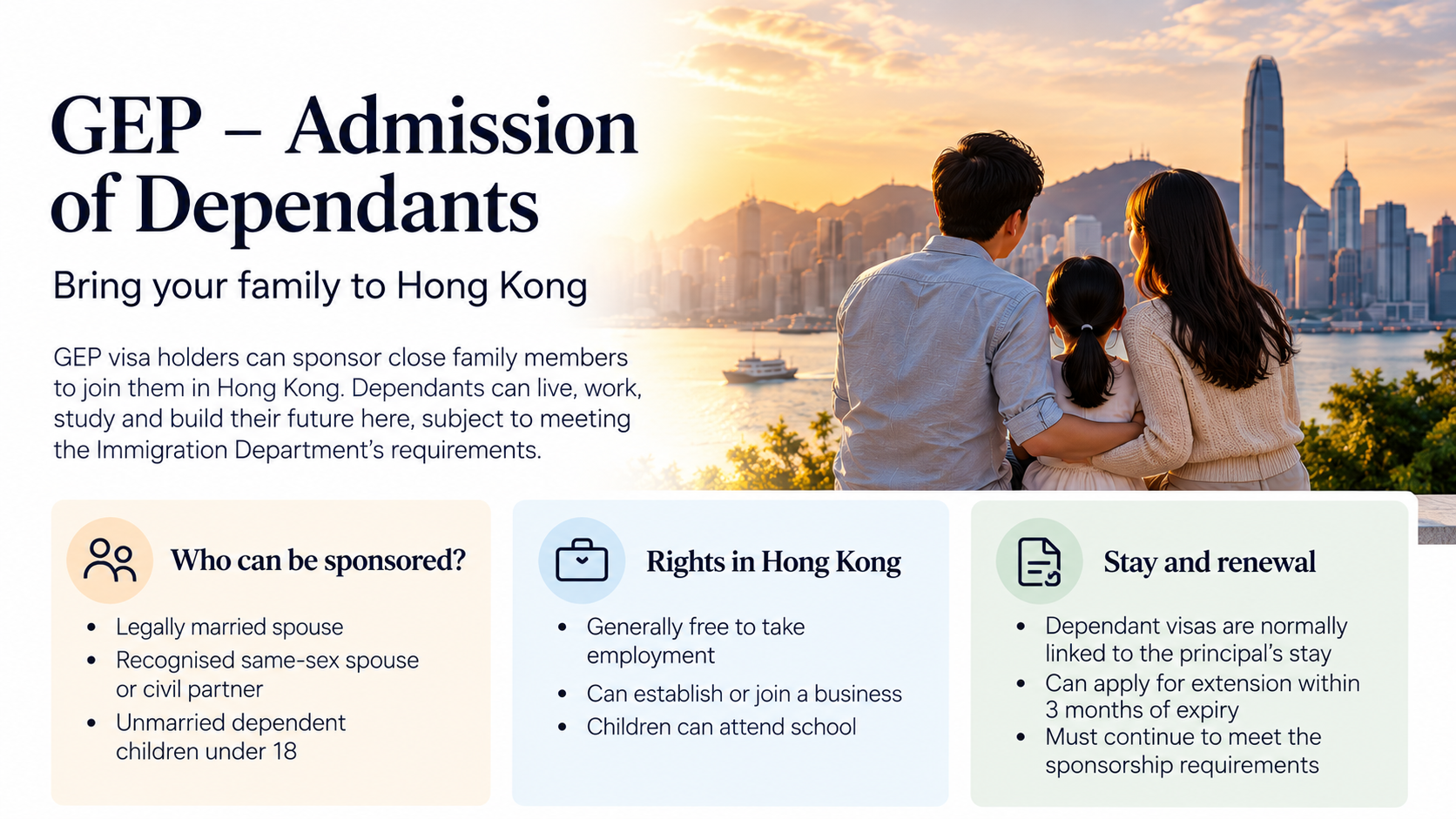
A professional admitted to Hong Kong under the General Employment Policy (GEP) may apply to sponsor eligible family members for residence under the Immigration Department’s prevailing Dependant Visa Policy.
This is an important feature of the GEP. The scheme is designed not merely to permit overseas professionals to undertake employment in Hong Kong, but also to allow qualifying family members to accompany or join them during their period of lawful residence.
However, the admission of dependants is not automatic. The Immigration Department (ImmD) separately examines the family relationship, the sponsor’s financial circumstances, the availability of suitable accommodation, and the applicable immigration requirements.
The essential distinction is that approval of the principal GEP employment visa establishes the basis for sponsorship, but does not guarantee the admission of accompanying family members. Practical approaches to navigating these criteria are discussed extensively across the Hong Kong Visa Sherpa Family Guidance and the Hong Kong Visa Geeza Dependant Visa Resources.
Eligible Dependant Categories
Under the current arrangements set out in the ImmD Guidebook for Entry for Residence as Dependants in Hong Kong, a GEP entrant may ordinarily sponsor the following family members:
Legally married spouse
A husband or wife whose marriage is legally recognised and supported by appropriate documentary evidence.
Recognised same-sex spouses and civil partners
The other party to a same-sex marriage, civil partnership or civil union legally entered into and officially recognised in the jurisdiction where it was celebrated. The policy also covers qualifying opposite-sex civil partnerships and civil unions. Such relationships must satisfy the Immigration Department’s requirements concerning legal recognition and the nature of the partnership. Informal cohabitation, engagement or an unregistered relationship does not, by itself, establish eligibility.
Unmarried dependent children under 18
Unmarried dependent children below the age of 18 may qualify for admission, subject to the applicable relationship and dependency requirements. The relevant relationship may be established through birth certificates, adoption documentation or other appropriate evidence.
Can GEP Holders Sponsor Their Parents?
A GEP entrant who is not a Hong Kong permanent resident cannot ordinarily sponsor elderly parents for residence under the standard dependant arrangements applicable to employment visa holders. The dependant route available to a GEP professional is principally directed towards qualifying spouses, recognised partners and unmarried dependent children under 18. A separate immigration basis may need to be considered for parents wishing to reside in Hong Kong.
Core Requirements for Sponsoring Dependants
The Immigration Department will ordinarily consider the following criteria:
- Genuine family relationship: The applicant must provide satisfactory evidence of a qualifying relationship with the GEP work visa sponsor. Marriage certificates, birth certificates, adoption records and legally recognised civil partnership documentation may be relevant.
- No adverse immigration record: There must be no known record detrimental to the dependant’s admission.
- Adequate financial resources: The sponsor must demonstrate the ability to support the dependant at a standard well above the subsistence level in Hong Kong. Unlike some talent admission schemes, the GEP is ordinarily based upon confirmed employment. Consequently, the sponsor’s employment contract, remuneration package and financial resources may provide important evidence of the ability to support accompanying family members. However, the existence of an employment contract does not automatically satisfy the financial requirement; the Department may consider the sponsor’s actual circumstances and the number of family members to be supported.
- Suitable accommodation: The sponsor must also demonstrate that appropriate accommodation is available for the family in Hong Kong. The suitability of accommodation may depend upon the size and composition of the family and individual circumstances.
Application Timing: Concurrent or Subsequent Admission
There are two principal approaches to dependant applications, as detailed in Hong Kong Visa Geeza’s Step-by-Step Sponsorship Guides:
- Concurrent submission: Eligible family members may apply alongside the principal GEP work visa applicant. This can be particularly convenient where the professional intends to relocate to Hong Kong with their family from the outset. The dependant applications are assessed separately, even where they are submitted as part of the same relocation process.
- Subsequent admission: A GEP work visa holder may also apply for eligible family members to join them after establishing residence in Hong Kong. This may be appropriate where the principal applicant wishes first to commence employment, arrange suitable accommodation or establish the necessary financial circumstances.
In either case, the applicant should be prepared to provide the relevant relationship, financial and accommodation documentation. Applications remain subject to the prescribed fees and the Immigration Department’s approval.
Privileges of GEP Dependants: Employment, Business and Education
One of the significant advantages of dependant status linked to the GEP is the flexibility generally available to accompanying family members:
| Activity | Position under GEP Dependant Status |
| Employment | Generally permitted without a separate employment visa |
| Establishing or joining a business | Generally permitted, subject to applicable business and licensing requirements |
| Education | Permitted, subject to institutional admission requirements |
| Residence | Normally linked to the principal sponsor’s permitted stay |
A spouse or qualifying partner admitted as a dependant of a GEP work visa professional is generally not prohibited from taking employment in Hong Kong. This can be particularly valuable for internationally mobile professional families. For example, the spouse of an overseas executive admitted under the GEP may ordinarily pursue employment opportunities without requiring separate sponsorship under the General Employment Policy.
Similarly, a dependant may establish or participate in a lawful business, subject to normal corporate and regulatory requirements. Dependent children may attend schools in Hong Kong, subject to the applicable admission and education arrangements.
Extensions of Stay for Dependants
The permitted stay of a dependant is normally linked to that of the principal GEP work visa sponsor. Accordingly, where the principal applicant obtains an extension of stay, eligible dependants may also apply to extend their permission via the GovHK Online Extension of Stay for Dependants portal.
Dependant extension applications may be submitted within three months before the existing limit of stay expires. The Immigration Department will consider whether the original sponsorship requirements continue to be satisfied, including:
- The continuing validity of the principal sponsor’s immigration status.
- Whether the sponsor remains a bona fide Hong Kong resident.
- Whether the qualifying family relationship continues to exist.
- Whether the sponsor remains able to support the dependant.
- Whether any material change in circumstances affects the basis of sponsorship.
A change in the marital relationship, the death of the sponsor or the loss of the sponsor’s qualifying immigration status may have significant implications for the dependant. For those navigating status adjustments following marital or family shifts, resources on Swapping from a Dependant Visa to an Employment Visa and Hong Kong Visa Sherpa’s Dependant Transition Pathways provide detailed guidance.
Dependants and Hong Kong Permanent Residence
Dependants who have ordinarily resided in Hong Kong for a continuous period of at least seven years may potentially qualify for permanent resident status under the statutory framework outlined in the ImmD Right of Abode Guidelines.
Their eligibility must be assessed individually. The fact that the principal GEP sponsor becomes eligible for permanent residence does not automatically mean that every accompanying family member has independently satisfied the statutory requirements. The duration, intent, and continuous nature of each person’s residence must therefore be evaluated on its own merits, as highlighted in Visa Geeza’s analysis on the Right of Abode.
Practical Guidance for GEP Families
Family immigration planning should begin alongside the principal employment visa application rather than being treated as an afterthought. Applicants should consider the documentary evidence required to establish qualifying relationships, the financial resources available to support accompanying family members and the practical arrangements for accommodation in Hong Kong.
Where spouses intend to work or establish businesses, the flexibility of dependant status may offer significant advantages. Equally, families should monitor the expiry dates of both the principal GEP permission and the dependant visas.
The key principle is straightforward: the General Employment Policy can provide an effective immigration route for an entire professional family, but the continued residence of dependants remains connected to the sponsor’s qualifying immigration status and the ongoing satisfaction of the family sponsorship requirements.
The Wider Economic Context: Hong Kong’s New Development Priorities
The evolution of the GEP should be considered alongside Hong Kong’s broader economic transformation. The Government’s first Five-Year Plan for 2026–2030 places substantial emphasis on innovation, artificial intelligence, robotics, advanced manufacturing and the development of Hong Kong’s role within the Greater Bay Area.
These priorities are relevant to the future composition of Hong Kong’s workforce. They also help explain the policy interest in attracting professionals with specialised expertise and technical capabilities. However, the Five-Year Plan does not itself replace the existing GEP eligibility requirements. Rather, it provides a strategic context in which the Government’s targeted admission arrangements, including the Talent List and Technical Professionals Stream, can be understood.
Practical Guidance for GEP Work Visa Applicants and Employers
Several practical conclusions follow from these developments:
- Identify the correct admission stream: Employers should determine whether the proposed applicant belongs under the conventional GEP, the Technical Professionals Stream, the Admission Scheme for Mainland Talents and Professionals (ASMTP) or another admission arrangement.
- Examine Talent List eligibility: Where a position falls within a qualifying occupation on the Talent List, relevant facilitation measures may simplify aspects of the application (e.g., local recruitment exemptions).
- Establish the genuine employment requirement: The proposed position should be commercially credible and supported by an appropriate employment arrangement, as highlighted in the Hong Kong Visa Geeza Employment Visa Guide.
- Assess remuneration against the market: Employers should not rely upon outdated assumptions concerning a universal minimum salary.
- Prepare additional evidence for start-ups: Newly established businesses may need to demonstrate their financial resources, commercial activities and genuine need for the proposed employee via comprehensive business plans.
- Plan employment changes carefully: Ordinary GEP holders must obtain prior approval from ImmD before taking up employment with a different employer.
- Prepare extensions early: Applicants should ensure that their employment records, supporting documentation and immigration status remain properly maintained well in advance of visa expiry.
The Wider Implications for Hong Kong Immigration Practice
The General Employment Policy remains one of Hong Kong’s principal mechanisms for admitting overseas professionals. But it now operates within a more sophisticated framework of targeted talent and manpower measures.
The expansion of the Talent List and the introduction of the Technical Professionals Stream demonstrate that Hong Kong is seeking to address specific skills shortages while preserving the established requirements governing professional employment. For employers, this creates additional opportunities to recruit internationally. For applicants, it makes the choice of immigration route and the quality of the supporting evidence increasingly important.
The central principle remains: a Hong Kong employment visa is not granted merely because an overseas individual has been offered a job. It is granted where the proposed employment satisfies the Immigration Department’s requirements and can be justified within Hong Kong’s Professional immigration framework.
Stephen Barnes – Hong Kong Visa Geza
More Stuff You May Find Useful or Interesting
The following five articles are from the existing Hong Kong Visa Geeza library. Each provides useful practical or historical guidance on employment visas.
The short paragraphs beneath them explain how the original content should now be understood in light of the current GEP framework and the developments addressed in this Practice Direction.
These sections can be copied directly beneath the main article.
1. New Graduate Management Trainee Position – Can You Get a Hong Kong Employment Visa?
2. Will Performance-Based Equity Compensation Suffice Instead of Cash Compensation for a Hong Kong Employment Visa?
This article raises an important practical issue for start-ups and emerging businesses seeking to employ overseas professionals while managing limited financial resources. Its discussion of equity-based remuneration remains particularly relevant in Hong Kong’s developing innovation and technology economy. However, applicants should distinguish the potential commercial value of share options or equity participation from the Immigration Department’s requirement that remuneration be broadly commensurate with prevailing market levels. There is no universal published minimum monthly salary under the conventional GEP, but neither should an employer assume that speculative or performance-dependent equity will automatically substitute for an appropriate remuneration package. Our latest Practice Direction places this question within the wider assessment of employer credibility, genuine employment, financial capacity and the commercial substance of the proposed position.
3. Can I Get an Employment Visa as an Intercompany Transferee?
This article remains a useful examination of how the General Employment Policy applies to professionals transferring to Hong Kong within an international corporate group, particularly where the applicant’s existing relationship with the overseas business is that of an independent contractor rather than a conventional employee. Its central guidance concerning the importance of establishing a genuine employment relationship and explaining the commercial rationale for the transfer remains relevant. However, intercompany transfers should not be treated as automatically qualifying for immigration approval merely because the applicant has an established association with the international business. The Immigration Department must still be satisfied that the proposed employment meets the applicable GEP requirements. Our latest Practice Direction also explains the current 36-month initial admission arrangement, the relevant facilitation measures and the importance of properly documenting the Hong Kong employing entity’s commercial activities and employment obligations.
4. Will My Hong Kong Employment Visa Be Compromised If I Leave My Job Due to Intolerable Working Conditions?
This article provides useful reassurance that an overseas professional admitted under the General Employment Policy is not permanently tied to a particular employer and may seek approval to take up alternative employment in Hong Kong. Nevertheless, its discussion should be read with two important qualifications. First, ordinary GEP permission remains subject to an employment condition, meaning that prior Immigration Department approval is generally required before commencing work for a new employer. Second, the article’s reference to an indicative minimum monthly salary of approximately HK$16,000 should not be treated as a current universal salary threshold. The Immigration Department instead assesses remuneration against prevailing market levels for the particular position. Our latest Practice Direction explains these requirements and distinguishes ordinary GEP employment conditions from the greater flexibility available to qualifying top-tier entrants.
5. How Does the Admission Scheme for Mainland Talents and Professionals Differ from the General Employment Policy?
This article provides valuable historical and practical context for understanding the relationship between the General Employment Policy and the Admission Scheme for Mainland Talents and Professionals. Its central distinction between the two admission arrangements remains important, particularly in determining the appropriate route for applicants according to their nationality, residence and individual circumstances. However, readers should now take account of the Technical Professionals Stream introduced in June 2025, which operates under both the GEP and ASMTP and provides a targeted pathway for qualifying non-degree technical professionals in designated skilled trades. The expansion of the Talent List and subsequent facilitation measures have also changed the evidential landscape for certain professional applications. Our current Practice Direction explains how these developments complement, rather than replace, the traditional professional employment assessment framework.
Got a Visa Question?
The General Employment Policy offers substantial opportunities for overseas professionals and Hong Kong employers, but the application process can raise complex questions concerning qualifications, salary levels, employer sponsorship, intercompany transfers, employment changes and extensions of stay.
If you are considering applying for a Hong Kong employment visa, recruiting an overseas professional or changing employers while holding GEP permission, ask the Hong Kong Visa Geeza a question.
We’ll help you understand the current Immigration Department requirements and how they may apply to your particular circumstances.
VisaGeeza.Ai – Making Hong Kong Immigration A Lot Easier

VisaGeeza.Ai – 13 Years In The Making
Check Out VisaGeeza.Ai
All Our Know-How : All Our Experience : Fully Interactive
100% FREE!
Please select the social network you want to share this page with:

The Hong Kong Visa Geeza (a.k.a Stephen Barnes) is a co-founder of the Hong Kong Visa Centre and author of the Hong Kong Visa Handbook. A law graduate of the London School of Economics, Stephen has been practicing Hong Kong immigration since 1993 and is widely acknowledged as the leading authority on business immigration matters here for the last 24 years.

