


How & Why Hong Kong Seeks To Attract Foreign National Talent
Posted in Employment Visas, Family Visas, Investment Visas, Long Stay & PR, Musing, Special Programmes, The Hong Kong Visa Geeza /
How & Why Hong Kong Seeks To Attract Foreign National Talent
The Hong Kong Talent Imperative: Strategic Evolution, Institutional Architecture & Practical Realities
The architecture of Hong Kong’s immigration system has long reflected its structural position as a global entrepôt, financial intermediary, and service-driven economy. Lacking domestic natural resources, the territory’s economic viability depends on human capital, international connectivity, rule-of-law infrastructure, and commercial mobility. In How & Why Hong Kong Seeks To Attract Foreign National Talent, Stephen Barnes, the Hong Kong Visa Geeza, sets out the fundamental rationale that has shaped Hong Kong’s talent admission framework:
“The immigration policy of the Hong Kong Government has historically been calibrated to ensure that the Special Administrative Region remains an open, competitive, and outward-facing international commercial center. By maintaining relatively straightforward, rule-based entry mechanisms alongside a low and simple tax regime, the administration recognizes that economic growth is inextricably linked to our ability to import professional, managerial, and specialist talent that local labor pools cannot immediately supply.”
Stephen Barnes – Hong Kong Visa Geeza
Over recent years, this talent mandate has moved from an open-door policy into a targeted economic strategy. Driven by demographic shifts, an aging workforce, regional competition, and broader structural realignments within the Guangdong-Hong Kong-Macao Greater Bay Area (GBA), the Hong Kong Government has overhauled its talent attraction machinery. The traditional reliance on employer-driven sponsorship has expanded to include multi-tiered human capital initiatives—most visibly through the Top Talent Pass Scheme (TTPS), the overhauled Quality Migrant Admission Scheme (QMAS), the Immigration Arrangements for Non-Local Graduates (IANG), and the expanded Short-Term Visitor Facilitation Scheme.
Yet, as the policy framework has evolved, the Immigration Department (ImmD) has introduced strict regulatory standards. The era of loose administrative approvals and unverified business claims has ended. Foreign talent, sponsoring employers, and international enterprises now face an immigration administration that balances talent recruitment with strict scrutiny of genuine economic contribution, corporate bona fides, and long-term tax integration.
Demographic Drivers and Economic Imperatives
Hong Kong’s talent policies are shaped by demographic realities. The territory faces an aging population, historically low fertility rates, and the retirement of a generation of experienced professionals. Between 2019 and 2023, these demographic pressures combined with structural outward migration to create acute skill gaps across financial services, technology, healthcare, logistics, and professional consultancy.
The administration’s policy response has been swift and deliberate. Hong Kong’s Chief Executive policy addresses set out targets to replenish the workforce, attract international enterprises, and position the city as the primary international innovation and technology hub under the National 14th Five-Year Plan. Attracting foreign talent is no longer just about filling individual vacancies under the General Employment Policy (GEP); it is a central pillar of population and economic planning.
Crucially, the government recognizes that human capital drives broader institutional stability. Highly skilled foreign professionals generate positive economic spillovers: they establish regional operational hubs, manage multinational legal and financial transactions, train local staff, contribute to the profits tax and salaries tax base, and create auxiliary demand across local housing, retail, and education sectors. The immigration policy framework serves as the gatekeeper, designed to attract elite global human capital while protecting local employment standards.
The Institutional Architecture: Core Admission Regimes
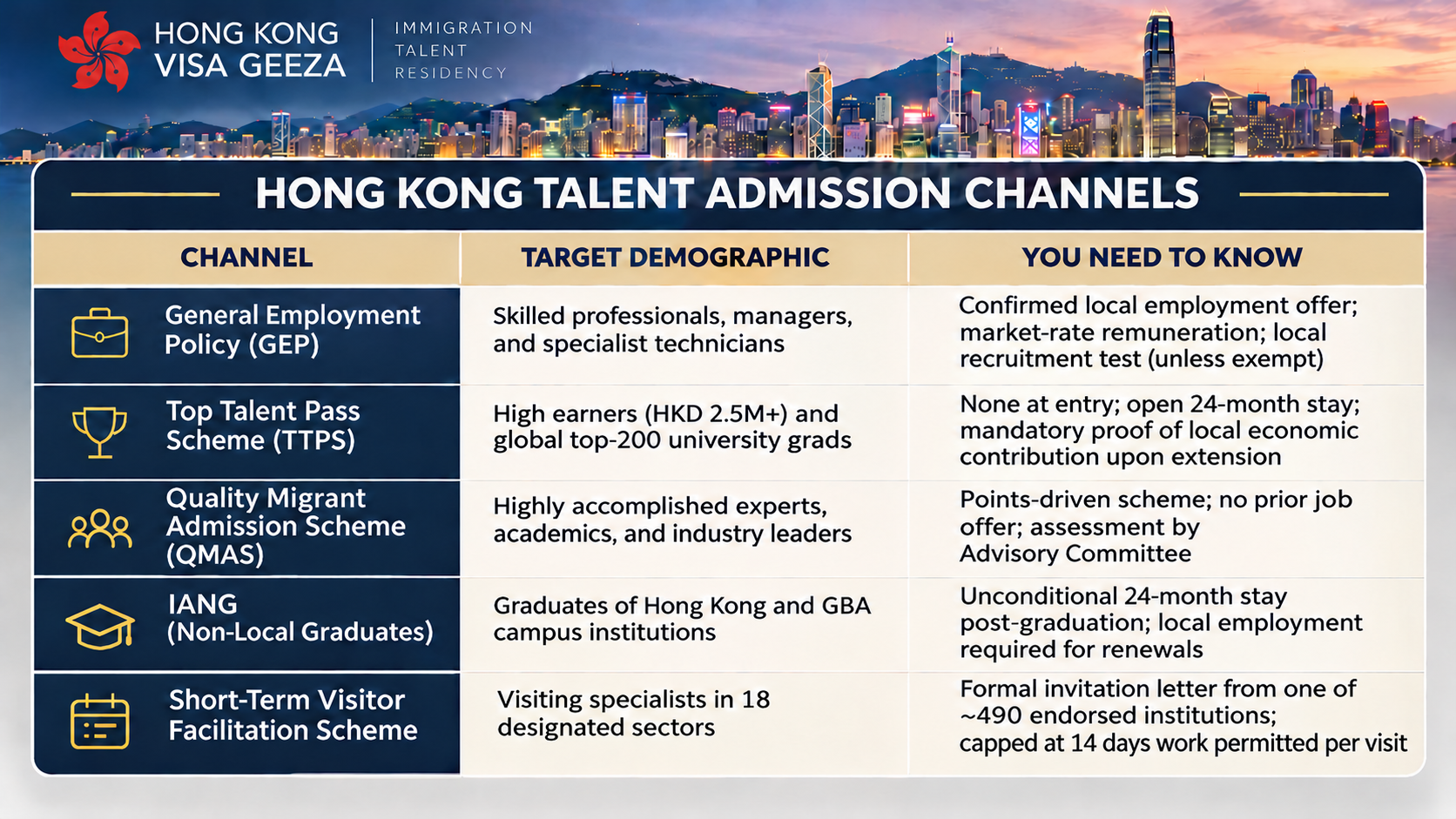
To achieve these strategic goals, the Immigration Department operates several distinct entry channels. Each regime serves a specific functional purpose within the broader economic ecosystem.
General Employment Policy (GEP)
The GEP remains the traditional foundation of Hong Kong’s employment immigration system. Available to foreign nationals possessing special skills, knowledge, or experience of value to and not readily available in the HKSAR, the GEP operates on an employer-sponsored basis. To succeed, an applicant must secure a confirmed employment offer with a remuneration package broadly aligned with prevailing local market rates.
Unless the position falls within the published Talent List or commands an annual salary of HKD 2 million or above, sponsoring employers must demonstrate that they conducted genuine local recruitment efforts without success before turning to an overseas candidate.
Top Talent Pass Scheme (TTPS)
Launched to rapidly draw high-calibre human capital into the territory, the TTPS bypasses the traditional requirement of an upfront job offer:
Category A: Individuals earning an annual taxable employment or business income of HKD 2.5 million (or foreign currency equivalent) or more in the year preceding the application.
Category B: Graduates of eligible world top-200 universities who have accumulated at least three years of work experience within the five years immediately preceding the application.
Category C: Graduates of eligible world top-200 universities who obtained their degree within the past five years but have less than three years of work experience (subject to an annual quota).
Successful applicants receive an initial two-year stay with unrestricted permissions to work, establish businesses, or change roles.
Quality Migrant Admission Scheme (QMAS)
Operating alongside the TTPS, the QMAS provides a points-driven pathway for individuals with proven professional achievements, academic credentials, and international expertise. Because QMAS does not require prior local employment, it attracts seasoned specialists, founders, researchers, and cultural practitioners seeking to relocate to Hong Kong autonomously. While processing timelines are longer than the TTPS, QMAS remains an important avenue for candidates whose profiles align with Hong Kong’s strategic priority sectors.
Immigration Arrangements for Non-Local Graduates (IANG)
The IANG route reflects the government’s strategy to retain talent educated in the city’s universities. Non-local students who graduate with a full-time accredited degree in Hong Kong can apply for a 24-month unconditional stay post-graduation, allowing them to enter the local workforce without an immediate job offer.
This policy has also expanded to cover graduates from mainland branch campuses established by Hong Kong universities (such as in Shenzhen and Guangzhou), integrating the broader Greater Bay Area talent pipeline into Hong Kong’s economic orbit.
Short-Term Visitor Facilitation Scheme
Recognizing that global commerce requires rapid, flexible access for specialist tasks, the government expanded the Short-Term Visitor Facilitation Scheme to 18 designated sectors. Qualifying international talent invited by one of roughly 490 government-endorsed host organizations can carry out specified professional activities—and receive remuneration where authorized—for up to 14 consecutive calendar days per visit without securing a full employment visa.
The scheme addresses the traditional friction where short-term, 10-day specialist assignments previously required months of standard visa processing.
Heightened Diligence: The Modern Adjudication Climate
While Hong Kong’s headline policies promote talent acquisition, operational reality inside the Immigration Department has evolved toward heightened scrutiny. The administration has adjusted its focus from talent acquisition volume to long-term economic integration.
Stephen Barnes outlines this shift in professional practice:
“Prospective applicants and sponsoring employers often make the fatal mistake of conflating immigration policy rhetoric with administrative reality. While the Government actively promotes Hong Kong as a magnet for global talent, the Immigration Department exercises an exacting level of forensic diligence on every individual application. The Department is not a rubber-stamping agency; case officers are legally tasked with verifying commercial substance, checking financial trails, and confirming that foreign talent is genuinely contributing to the local economic fabric rather than exploiting convenient immigration loopholes.”
Stephen Barnes – Hong Kong Visa Geeza
This administrative shift impacts every major category of visa adjudication:
Forensic Scrutiny of Corporate Sponsors
Under the GEP, the Immigration Department evaluates the sponsoring entity just as closely as the candidate’s qualifications. To be deemed a “suitable and credible sponsor,” an employer must demonstrate real operational substance:
Dedicated Commercial Premises: Applications relying on residential addresses, virtual offices, or shared hot-desking setups without dedicated physical space face immediate challenges. The Department expects an operating corporate footprint.
Local Employment Foundation: Sponsoring firms must prove they actively employ local Hong Kong permanent residents, substantiated through Mandatory Provident Fund (MPF) contribution schedules. A company attempting to sponsor foreign executives without employing any local staff faces intense departmental inquiry.
Financial Solvency and Tax Compliance: Sponsoring businesses must submit audited financial statements, profits tax returns, and corporate bank records showing the enterprise has the financial runway to sustain the candidate’s salary and fulfill operational obligations.
The TTPS Extension Reckoning
The initial wave of TTPS entrants who arrived on open two-year grants now face their first extension cycles. The Department’s extension requirements are rigorous. An applicant holding an initial TTPS grant cannot secure an extension simply by demonstrating physical presence or passive capital.
To renew their stay, a TTPS holder must provide evidence of qualifying local employment (substantiated by employment contracts, monthly payroll records, salaries tax returns, and employer MPF payments) or demonstrate that they have founded a genuine, operational commercial enterprise that actively contributes to Hong Kong’s economy. Those who treated the TTPS as a casual travel document without building real economic ties find their renewal applications refused.
Enforcement Against Sham Arrangements and Border Exploitation
The Immigration Department has expanded enforcement against contrived employment arrangements and sham business setups. Case officers look closely at shell companies set up to self-sponsor an employment visa, arrangements where foreign nationals pay intermediaries to pose as employers, or non-residents using visitor status to work unofficially. See the Immigration Department’s official enforcement announcement (23 July 2025) and its 2025 enforcement review.
Similarly, the practice of conducting repeated border runs via Shenzhen or Macau to maintain de facto visitor residence is met with computerized flags, truncated landing limits, and secondary examination refusals at control points.
The Hong Kong Value Proposition for Global Professionals
Even with heightened administrative diligence, Hong Kong remains an exceptionally attractive destination for international talent. The institutional advantages that underpin the city’s competitiveness continue to draw professionals from across the globe:
Simple, Low-Tax Framework: Hong Kong’s salaries tax regime remains capped at a standard rate of 15% (or a progressive rate maxing out at 17% after personal allowances), with no capital gains tax, no dividend withholding tax, no estate duty, and no VAT/sales tax. This allows top-tier earners to retain a significantly higher proportion of their compensation compared to other global financial centers.
Rule of Law and Institutional Infrastructure: Operating under the common law tradition within the “One Country, Two Systems” framework, Hong Kong provides contractual certainty, intellectual property protection, free capital convertibility, and an independent judiciary.
Family-Friendly Dependent Rights: Unlike jurisdictions that restrict family members to passive visitor or non-working status, Hong Kong allows dependants of foreign professionals (spouses and unmarried dependent children under 18) to work freely, establish commercial enterprises, or enroll in local and international schools without requiring separate Immigration Department permissions.
Path to Permanent Residency: Any non-Chinese national who has entered Hong Kong lawfully under a qualifying employment, entrepreneur, or student visa and resided continuously for a minimum period of seven years may apply to acquire the Right of Abode, obtaining permanent resident status, local voting rights, and the unconditional right to live and work in the territory without visa sponsorship.
Strategic Protocols for Corporate and Individual Applicants
Navigating Hong Kong’s immigration landscape requires clear procedural planning and alignment between corporate strategy and statutory requirements.
For Corporate Sponsoring Entities
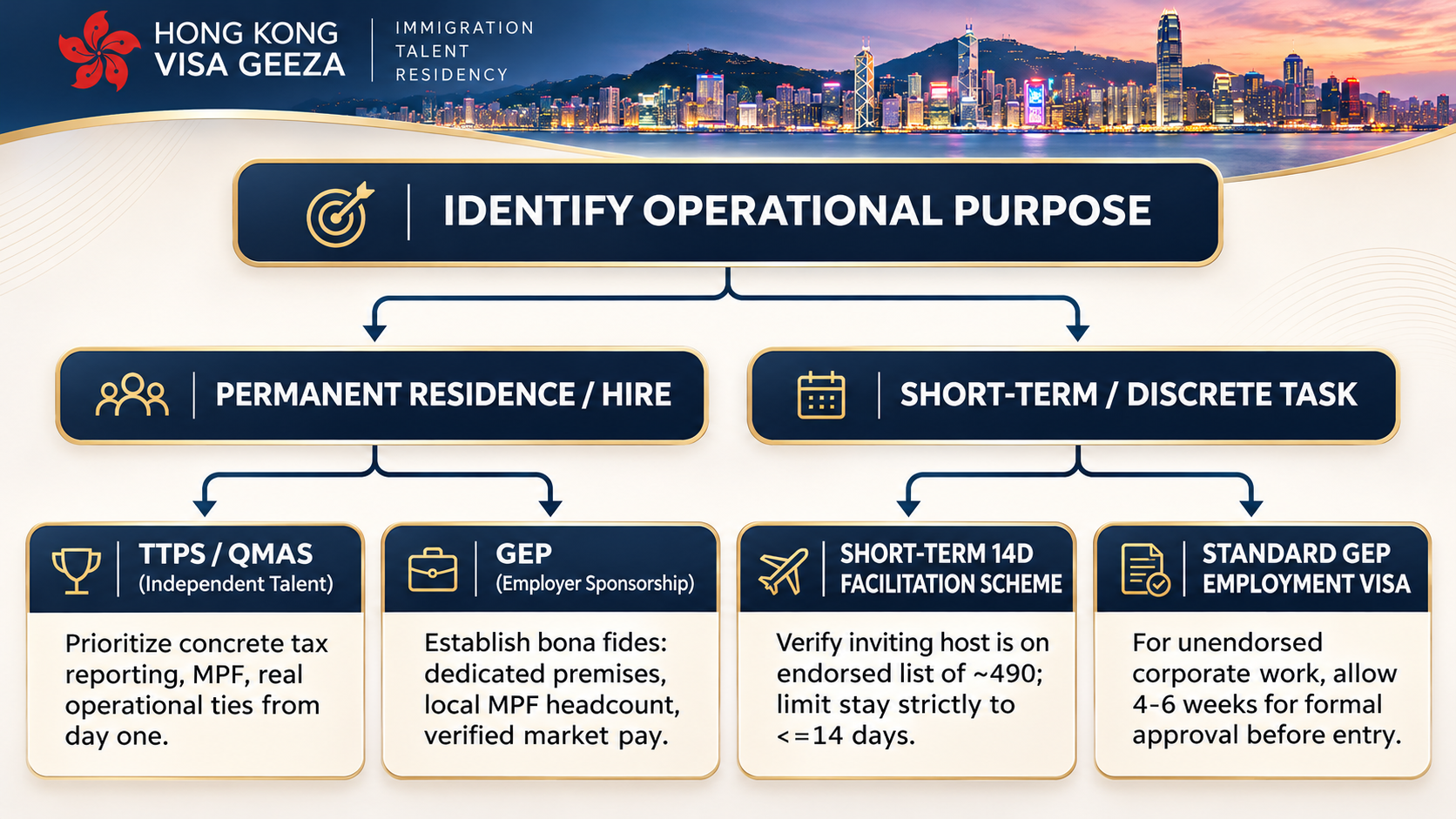
- Audit Corporate Infrastructure: Before filing a GEP application, review the corporate profile. Ensure office leases, audited accounts, valid Business Registration certificates, and local employee MPF contribution schedules are organized and up to date.
- Document Market Reality: When creating a foreign specialist role, articulate precisely why the required skill set is not readily available within the local labor pool. Keep contemporaneous records of local recruitment efforts, job board listings, and candidate interview assessments.
- Ensure Remuneration Alignment: Remuneration packages must match current local market rates for comparable senior positions. Below-market salary offers trigger administrative questions and prolong processing.
For Individual Talents and Relocating Professionals
- Prepare for Extensions Early: TTPS and QMAS holders must treat their initial two-year grant as a preparatory window to build documented, verifiable economic roots in Hong Kong. Secure local employment or establish a compliant, operating business well before the renewal deadline.
- Maintain Strict Record Discipline: Keep contemporaneous records of employment contracts, monthly salary slips, local bank account statements, tax demand notes, and MPF records.
- Respect Visitor Boundaries: Never take up employment, deliver client services, or execute commercial tasks on an ordinary visitor visa or landing slip. If an assignment is short-term, ensure it is properly channeled through the Short-Term Visitor Facilitation Scheme with an accredited institutional host; otherwise, secure formal GEP employment clearance before touching down at Chek Lap Kok.
Hong Kong’s talent attraction policies will continue to serve as a key economic pillar for the territory. For the international professional and multinational enterprise, the city offers unmatched commercial access and tax efficiency- provided they approach the Immigration Department’s regulatory standards with professional rigor, documentary precision, and institutional respect.
More Stuff You May Find Useful or Interesting
Lame Excuses Won’t Cut It If You’re Caught Working In Hong Kong Without An Employment Visa
In this piece, Stephen Barnes addresses the severe legal fallout awaiting foreign nationals caught working in Hong Kong without proper employment status. The Geeza underscores that Section 41 of the Immigration Ordinance imposes strict liability: arguments claiming an overseas contract, offshore salary disbursement, lack of local remuneration, or mere uncompensated internship/trial work are summarily dismissed by the courts. Conviction carries maximum statutory penalties of up to HKD 50,000 in fines and two years’ imprisonment for unauthorized workers, alongside severe corporate sanctions of up to HKD 350,000 and three years’ imprisonment for employing entities under Section 17I.
Today, ImmD joint enforcement taskforces (alongside the Hong Kong Police and Labour Department) operate with unprecedented data-matching capabilities, regularly conducting on-site workplace raids across conventional commercial offices, co-working facilities, and exhibition venues. Adjudication practice offers zero leniency for informal work trials. Unless an individual is formally sponsored under the General Employment Policy (GEP) or participating in an authorized short-term activity endorsed under the 14-day Facilitation Scheme across the 18 designated sectors, any physical on-site professional execution constitutes a criminal breach resulting in immediate arrest, deportation, and a lasting immigration blacklist.
Change To Hong Kong Employment Visa From Visitor Visa Status
This practical guide breaks down the procedural path for foreign nationals physically present in Hong Kong as visitors who receive a local job offer and seek an employment visa. The Geeza clarifies that while attending exploratory interviews and negotiating terms as a visitor is lawful, commencing employment duties prior to formal visa issuance is illegal. Once an onshore application under the General Employment Policy is approved, the candidate cannot automatically begin working; they must depart Hong Kong (typically via a quick Macau or boundary crossing) and re-enter to activate their employment permissions at the control point.
In contemporary practice, ImmD has digitized this entire workflow via the GovHK electronic services portal, issuing downloadable e-Visas. However, procedural diligence has intensified dramatically: ImmD strictly scrutinizes the timeline between visitor arrival and job offer acceptance to detect premeditated, unauthorized working arrangements. Applicants cannot use a pending online GEP application as a shield to prolong visitor status repeatedly. Crucially, the requirement to exit and re-enter the HKSAR to activate the approved employment status remains mandatory before any productive employment or payroll onboarding can commence.
Can I Lawfully Rent An Apartment In Hong Kong As A Frequent Visitor – What Would The Immigration Department Make Of That?
Here, the Visa Geeza explores whether a non-resident who frequents Hong Kong for extended visits can execute a standard residential tenancy agreement without violating immigration rules. Barnes clarifies that Hong Kong property and contract law does not restrict private landlords from leasing residential premises to foreign passport holders, nor does entering a tenancy constitute an immigration offense in itself. However, possessing a long-term local lease while traveling on visitor permissions creates a glaring evidential footprint that boundary control officers will scrutinize whenever examining the entrant’s genuine purpose of stay.
Under present-day electronic border surveillance, ImmD systems cross-reference travel frequencies and onshore duration against residential indications. Holding an apartment lease without resident status immediately raises presumptions of unapproved de facto residence or covert remote employment under Section 41. Officers conducting secondary examinations at boundary checkpoints demand clear documentary evidence of overseas primary residence, independent financial solvency, and verifiable, non-working travel itineraries. If suspicions of unauthorized local living arise, officers now truncate landing slips or issue outright entry refusals, rendering the leased apartment inaccessible.
Can I Set Up A Hong Kong Company, Employ My Business Partner & Sponsor An Employment Visa For Him?
This analysis evaluates the feasibility of an entrepreneur establishing a private Hong Kong company to immediately sponsor an employment visa for their overseas business partner. The Geeza explains that ImmD treats such arrangements as veiled investment/entrepreneur applications rather than arms-length employment. If the sponsored employee holds equity, shares founding control, or participates in initial venture risk, the Department bypasses standard GEP employment assessment criteria and tests the company against the rigorous investment approvability benchmarks, assessing capital capitalization, commercial viability, and local economic contribution.
Current administrative policy post-2026 has made this route exceptionally demanding. ImmD forensically examines corporate shareholding registers and bank statements to weed out self-sponsorship stratagems. If equity ties exist, the sponsoring vehicle cannot simply present nominal paid-up capital and a virtual office. ImmD requires proof of HKD 1.5M–2.0M in deployed working capital, an executed commercial lease for exclusive physical premises, and active MPF payroll contributions for 2–3 local permanent residents. Attempting to disguise an equity partner as an ordinary salaried hire invites immediate refusal and administrative red flags.
Hong Kong Work Visa – Is 2 Years Post Graduation Work Experience An Absolute Prerequisite?
The Geeza unpacks the pervasive industry myth that applicants seeking a Hong Kong employment visa under the General Employment Policy must possess at least two years of post-graduation managerial or supervisory experience. Barnes clarifies that while two years of relevant experience is a standard administrative benchmark used by case officers to gauge professional competence, it is not a rigid statutory requirement. Exceptional academic credentials, specialized technical expertise, or niche industry skills in high local demand can persuade ImmD to exercise discretion and grant an employment visa to recent graduates.
Today, this flexibility is framed by Hong Kong’s targeted talent initiatives and the published Talent List. While the Top Talent Pass Scheme (TTPS Category C) and IANG schemes offer explicit entry avenues for recent graduates, standard GEP applications for junior foreign professionals face heightened employer-side justification. Sponsoring enterprises must submit comprehensive market documentation demonstrating that the candidate possesses specialized technical competencies not readily available in the local workforce, alongside offering remuneration packages matching prevailing graduate market rates, to successfully overcome the absence of two years’ post-qualification experience.
Does Time Spent Outside Of Hong Kong Working For A Hong Kong Employer Break Continuity Of Residence For PR Purposes After 7 Years?
This publication examines the legal mechanics of continuous ordinary residence under Section 2(4)(b) of the Immigration Ordinance for foreign residents pursuing Right of Abode (Permanent Residency) after seven years. The Geeza addresses scenarios where an employment visa holder is temporarily secondment-assigned overseas by their Hong Kong employer. Barnes clarifies that temporary absences do not break continuity of ordinary residence provided the applicant maintains a clear, documented “nexus” to Hong Kong throughout the period, establishing that the territory remains their permanent home and the absence is strictly temporary.
In current PR adjudications, ImmD exercises stringent documentary scrutiny regarding overseas secondments. Applicants must substantiate the ongoing Hong Kong nexus through concrete records: continued payment under a Hong Kong employment contract, active Mandatory Provident Fund (MPF) contributions, continuous filing of Hong Kong Salaries Tax demand notes, maintaining local bank accounts, and evidence of local residential accommodation or family members remaining onshore. Gaps where local tax and MPF were severed will lead case officers to declare a break in continuous residence, resetting the seven-year statutory clock back to day zero.
Can You Study In Hong Kong If You Only Possess A Visitor Visa Here?
This article tackles the common query of whether an individual present in Hong Kong on a visitor landing slip can enroll in educational courses, language classes, or professional training programs. The Geeza explains that Section 41 conditions of stay explicitly prohibit visitors from studying at any school, university, or educational institution. Whether the study is full-time, part-time, credit-bearing, or purely recreational, enrolling without formal student entry clearance from the Director of Immigration constitutes a direct, prosecutable breach of conditions of stay.
Modern enforcement extends this prohibition across all registered private academies, language institutes, and tertiary establishments, which are legally required to verify valid student visa status prior to enrollment under penalty of aiding and abetting an immigration offense. The sole exception exists under the expanded Short-Term Visitor Facilitation Scheme across the 18 designated sectors, which permits invited scholars and specialists to participate in approved short-term academic exchanges or research activities for up to 14 days. Outside this accredited institutional framework, any course of study demands a fully approved, pre-arranged student visa.
VisaGeeza.Ai – Making Hong Kong Immigration A Lot Easier

VisaGeeza.Ai – 13 Years In The Making
Check Out VisaGeeza.Ai
All Our Know-How : All Our Experience : Fully Interactive
100% FREE!
More Stuff You May Find Useful Or Interesting
The 10 Key Reasons Why Foreigners Come To Live And Work In Hong Kong
How To Stop Worrying And Start Applying For Your Hong Kong Visa
Can I Apply For A Residence Visa Before Or After I Move To Hong Kong?
What Are You Really Buying From A Hong Kong Immigration Consultant?
STOP PRESS! Hitler’s HKSAR Passport Application Has Been Rejected!
Please select the social network you want to share this page with:

The Hong Kong Visa Geeza (a.k.a Stephen Barnes) is a co-founder of the Hong Kong Visa Centre and author of the Hong Kong Visa Handbook. A law graduate of the London School of Economics, Stephen has been practicing Hong Kong immigration since 1993 and is widely acknowledged as the leading authority on business immigration matters here for the last 24 years.

